
An overview of the structural gaps determining patient access to nuclear medicine across Europe
With more than 10 million procedures performed annually in Europe, nuclear medicine plays a vital role in modern healthcare, from early cancer detection to targeted therapies that are transforming patient care. Nuclear medicine is advancing at an unprecedented pace, with radioligand therapies and theranostics moving into routine oncology care, while imaging is becoming more sensitive and accurate. Yet ensuring that European patients can fully benefit requires five structural challenges to be addressed:
- Ensuring the security and reliability of isotope supply
- Delivering radiopharmaceuticals to patients
- Dosimetry for therapeutic radiopharmaceuticals
- Harmonisation of European legislation
- Workforce development and growing future talent
The following sections provide a brief overview of each barrier to patient access, with links to dedicated publications and policy recommendations.
1. Ensuring the security and reliability of isotope supply
Due to limited usable lifespan, radiopharmaceuticals must be handled as efficiently as possible. With isotope half-lives ranging from one hour to eight days, products are typically produced and shipped within 24 hours and used directly on arrival. Any delay can make them unusable. This makes supply security a permanent challenge. As an example, around 85% of diagnostic scans worldwide depend on Molybdenum-99 (Mo-99) and its daughter Technetium-99m (Tc-99m). Yet Mo-99 is currently produced in only six research reactors, four in Europe and two in South Africa and Australia. The reactors do not run continuously. Many are up to 60 years old, and although new reactors are being built, they are not expected online before 2030. Unexpected downtimes require schedules to be adapted dynamically.
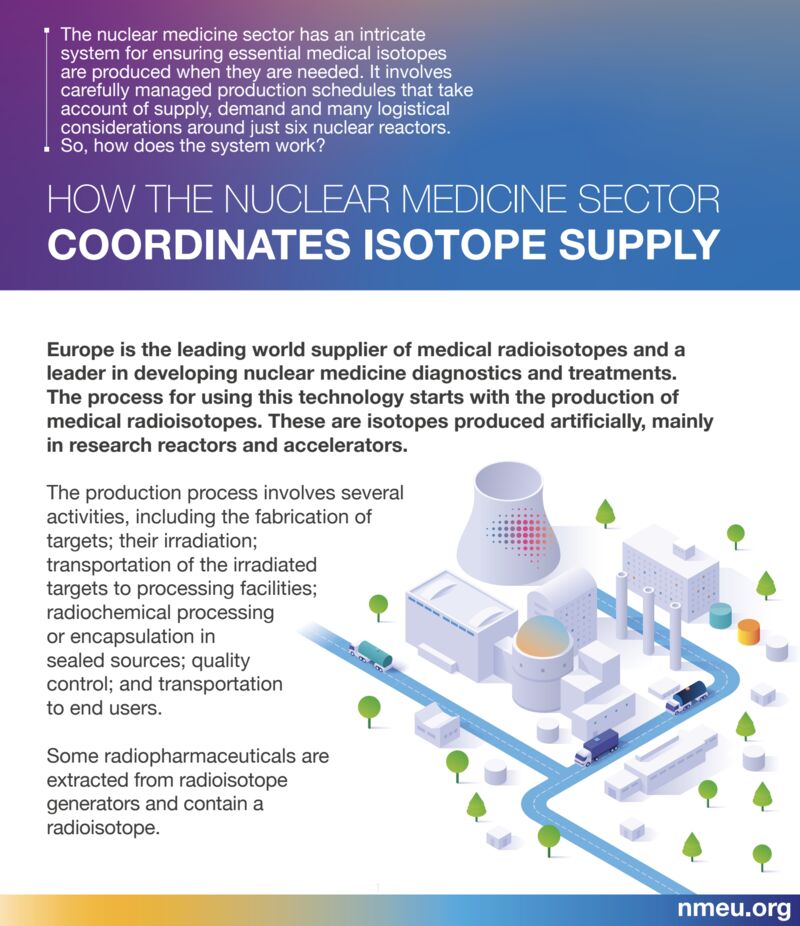
Nuclear Medicine Europe manages this system through the European Observatory on the Supply of Medical Radioisotopes, a long-standing partnership with the Euratom Supply Agency, and its own Security of Supply Working Group. The Working Group ensures the coordination of production from reactor operators to mitigate shortages.
2. Delivering radiopharmaceuticals to patients
Nearly all short-lived medical radionuclides and radiopharmaceuticals are shipped to hospitals in a certified container designed to safely transport low to moderate activity radioactive materials (known as Type A packages). Two regulatory developments currently threaten this model.
The first concerns the ongoing revision of the IAEA Regulations for the Safe Transport of Radioactive Material (SSR-6). The revision proposes significant changes in radioactivity values that would force manufacturers and nuclear pharmacies to use far more demanding Type B packaging (designed for significantly higher radioactivity levels) for specific isotopes. With the increasing relevance of promising therapies in the field, the consequences could be severe, including a shortage of innovative treatments.
Secondly the European Chemicals Agency has recommended lead metal be included within the REACH Authorisation List. Lead remains indispensable for radiation shielding during the transport and handling of radiopharmaceuticals. A ban could render existing lead-lined installations obsolete, raise costs and cause delays as alternatives carry practical, economic or regulatory drawbacks.
3. Dosimetry for therapeutic radiopharmaceuticals
Therapeutic radiopharmaceuticals are administered systemically. Unlike external beam radiotherapy or brachytherapy, where the dose is delivered locally and can be tightly controlled in space, time and intensity, the absorbed dose depends on how the molecule distributes through the body and on patient-specific kinetics. Dosimetry, the measurement and calculation of radiation delivered to tissue, works differently for radiotherapeutics. It typically requires imaging patients at multiple time points after administration to estimate the absorbed radiation dose in tumors and healthy organs.
This complexity has fueled ongoing debate about when and how dosimetry should be required in clinical development and routine practice. While the role of dosimetry in clinical routine continues to be debated, Nuclear Medicine Europe’s position is clear: dosimetry is a valuable tool in early radiopharmaceutical development and should be systematically pursued in early clinical trials. However, individual dosimetry-guided dosing should not be made compulsory in large late-stage trials or routine practice in the absence of validated methodology and demonstrated clinical benefit.
4. The crucial need for harmonisation of European legislation
Nuclear medicine operates under dual governance of pharmaceutical legislation and radiation-safety regulation. These frameworks are sometimes contradictory, and considered overly complex and fragmented.
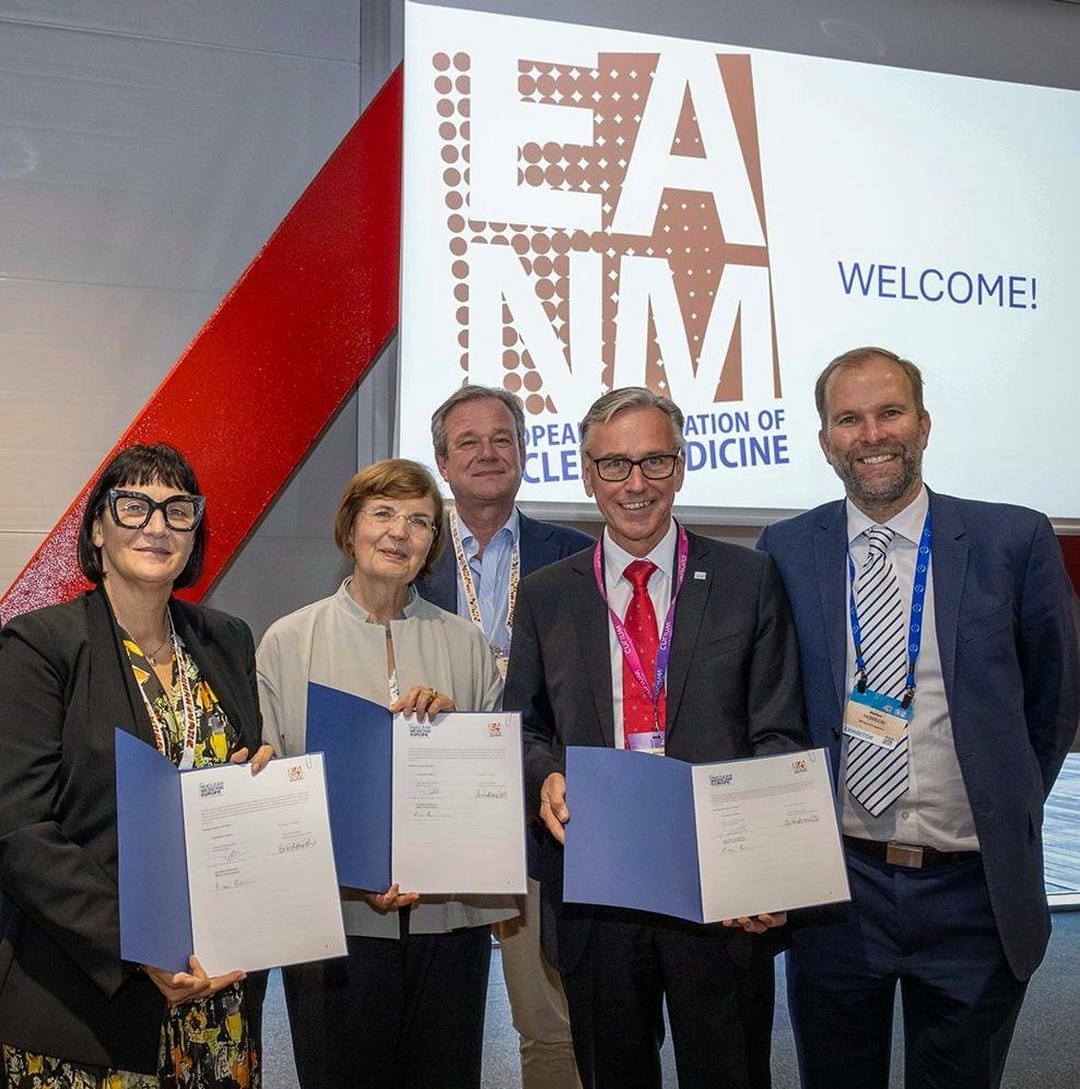
In October 2025, Nuclear Medicine Europe signed a Memoranda of Understanding with the EANM and the Heads of the European Radiological Protection Competent Authorities (HERCA) to establish structured frameworks that span pharmaceutical and radiopharmaceutical legislation, quality assurance and standardisation, as well as engagement with European institutions. The aim is to create a more unified European legislative framework.
Read more : Activity Report 2025 – Part 1 & Activity Report 2025 – Part 2
5. Workforce development and growing future talent
Translating scientific advances into patient benefits depends on attracting professionals to disciplines such as radiochemistry, radiopharmacy, medicine, and engineering. As nuclear medicine expands, a shortage of specialists is already apparent.
To better understand the barriers to entry, Nuclear Medicine Europe interviewed a clinician at the forefront of both practice and education: a hospital nuclear medicine department director who also teaches the specialty at university level. His account identifies what drives – and what discourages – students and young professionals – from choosing nuclear medicine as a career.

These five challenges share a common thread: nuclear medicine’s rapid clinical progress is now outpacing the regulatory, logistical, and human infrastructure needed to deliver it at scale. Addressing them will depend as much on coordination, investment and coherent European policy as on scientific innovation itself. Nuclear Medicine Europe remains committed to engaging with all necessary stakeholders to secure patient access to innovative radiopharmaceuticals across Europe.
An initiative from the Communications Working Group of Nuclear Medicine Europe